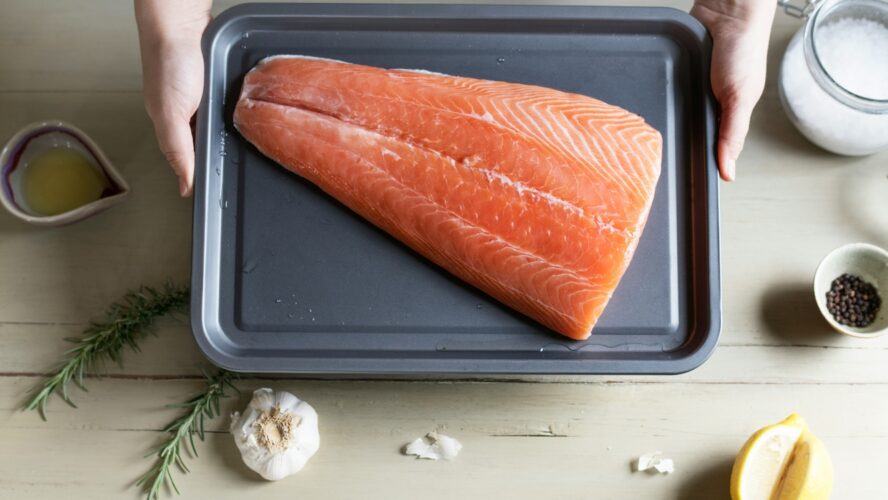
Salmon is without doubt one of the hottest fish within the U.S., and it’s not exhausting to see why. With its silky, buttery flesh wealthy in heart-healthy omega-3 acids, salmon is a scrumptious and good addition to any food plan. It ought to come as no shock, then, that previously 30 years, salmon’s reputation has soared: The worldwide salmon market has elevated from 500,000 tons to three million1, and the typical American eats greater than three kilos of salmon annually.
However whereas this behavior could also be heart-healthy, it isn’t essentially probably the most sustainable selection. Many salmon populations are severely overfished, and compounded with the results of local weather change warming the rivers salmon navigate to spawn2, there’s a main shortage within the wild salmon division. Enter farmed salmon — an answer that has solved some issues and precipitated much more.
Need extra heatlh and wellness information? Join the e-newsletter for extra well-researched, non-toxic dwelling steering and good wellness recommendation.
The Introduction of Farm-Raised Salmon
America’s first salmon farms had been first established within the ‘70s, and as of late, greater than 70 p.c of the salmon we eat is farm-raised3. However salmon farms, that are usually suspended within the open ocean, have the potential to be an environmental blight. The manufacturing unit farm circumstances afflicting land farming are simply as relevant to aquaculture (assume the GMO salmon experiment), and less-than-ideal circumstances imply these farms pollute the ocean with antibiotics, hormones, waste, and sickness.
Whereas strides have been made in recent times to enhance the environmental footprint of salmon aquaculture, the waters are nonetheless typically murky in relation to deciding between wild-caught salmon vs. and farmed-raised. So how do you select? Right here’s a breakdown of what to contemplate.
Taste of Wild vs. Farmed Salmon
Many level to taste because the core issue of their determination on wild vs. farmed salmon. And there may be undoubtedly a distinction — but it surely won’t be what you anticipate. A blind style check carried out by the College of Copenhagen in 2021 confirmed that buyers truly choose the farmed stuff4.
Wild-caught salmon tends to have a extra strong taste than farmed, which tends to be milder and extra buttery. In the end, the winner within the taste battle of farmed vs. wild salmon comes all the way down to desire. In case you like fattier, extra luxurious salmon, you’ll doubtless choose farmed; in case your palette leans in the direction of a fishier style, wild salmon is your greatest guess.
Well being Advantages of Wild vs. Farmed Salmon
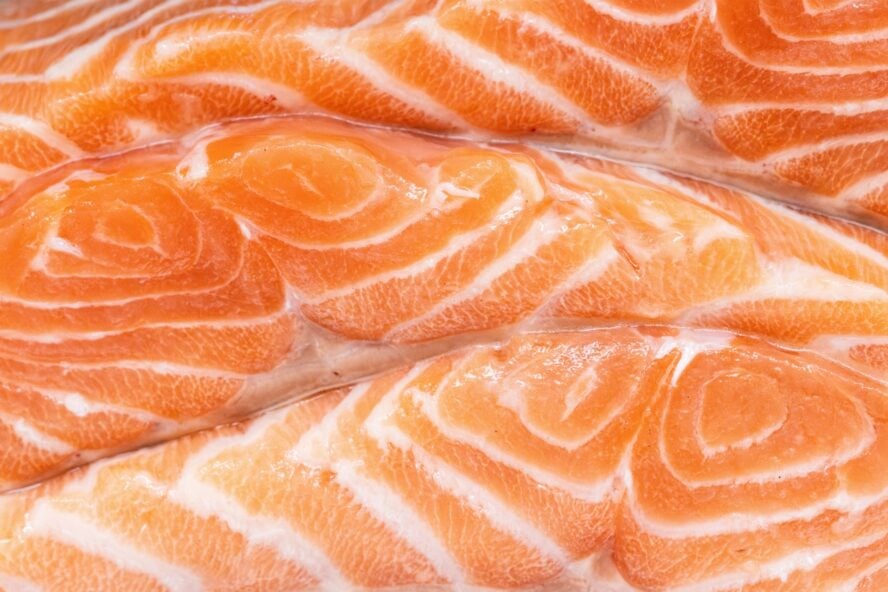
Another excuse that some would possibly select wild salmon over farmed has to do with the well being advantages. Whereas each wild and farmed salmon include the heart-healthy omega-3s which have the potential to protect in opposition to cognitive decline5, despair6, heart problems7, and even most cancers8, 2020 analysis in Meals discovered that wild salmon has a greater stability of omega-3 to omega-6 fatty acids9.
However is farmed salmon unhealthy? Quite the opposite — specialists say this distinction is minor in relation to looking for probably the most nutritious salmon. A 2014 examine confirmed that consumption of farmed salmon nonetheless did certainly modify plasma ranges of each omega-3 and omega-6 fatty acids at ranges related to a decreased danger of heart problems10.
As Stefanie Colombo, an affiliate professor in aquaculture vitamin at Dalhousie College in Canada, informed the New York Instances, “there’s not a lot distinction between wild and farmed” from a dietary perspective11. Her analysis discovered that whereas wild sockeye and wild chinook had been probably the most nutrient-dense, farmed Atlantic salmon solely had barely decrease ranges of healthful vitamins, and wild Pacific salmon had even much less12.
Contaminants in Wild vs. Farmed Salmon
On the subject of mercury and different contaminants, farmed salmon is best for you than wild. In line with Colombo’s analysis, farmed Atlantic salmon had decrease mercury ranges than wild-caught varieties. However even within the case of untamed Atlantic salmon, contaminant concentrations are “properly beneath” most accepted EU ranges13.
On the finish of the day, the distinction in well being advantages between farmed vs. wild salmon is negligible sufficient that it shouldn’t be a significant component in your selection.
Environmental Affect of Salmon: Wild vs. Farmed
Neither wild nor farmed salmon is ideal in relation to environmental influence. Many salmon fisheries are severely overfished — of the 127 types of salmon Seafood Watch covers, solely 39 are licensed as sustainable14. However whereas meals journalist Mark Bittman says that “neighborhood aquaculture has been practiced sustainably for hundreds of years, from the standard fishponds of Hawai’i, to the oyster beds of the Romans,” the fashionable strategy is something however.
Most fish farms are extremely intensive, resulting in poor well being among the many fish. Salmon particularly are usually farmed within the ocean in open-net pens or submerged cages, introducing antibiotics and fish waste into the oceans.
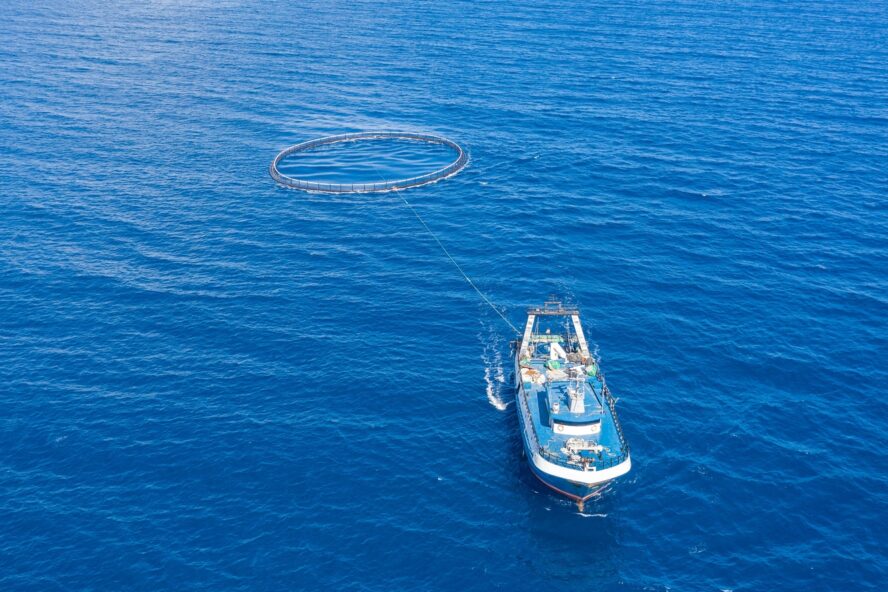
On the subject of carnivorous fish like salmon, the environmental influence of aquaculture will get even worse. Salmon have an unsustainable protein conversion ratio, and in the end, salmon farming consumes twice as a lot fish than it produces15.
Whereas some producers have begun testing extra sustainable, low-input aquaculture initiatives, the labeling requirements for salmon are something however clear. The Guardian studies that Scottish fish farms have turn into a specific drawback, masquerading as natural whereas additionally allowing poisonous chemical compounds and experiencing excessive mortality charges16.
In the end, probably the most sustainable salmon farms take salmon farming out of the ocean fully, with strategies like Zero Waste Recirculating Aquaculture Programs (Z-RAS) which can be land-based and fully impartial of the oceans. Regardless of the problems rampant in aquaculture, we’re nonetheless making some progress — GMO salmon is not commercially obtainable, and the FDA even just lately accepted the very first lab-grown salmon.
Worth of Wild-Caught vs. Farmed Salmon
Wild-caught salmon has traditionally been considerably dearer than farmed — typically two to 3 instances the worth17. However this will not be the case for for much longer. Producing extra sustainable farmed fish comes at a price — a price that buyers must be prepared to pay in the event that they’re going to proceed to indulge.
Which to Select?
Neither wild nor farmed salmon is fully excellent, and there are good decisions in each classes. Erin Hudson, program director of the Monterey Bay Aquarium Seafood Watch program, says when you’re selecting wild-caught salmon, “a very good rule of thumb is to purchase U.S. wild-caught salmon. In actual fact, solely a tiny quantity is red-rated.” Wild-caught salmon from Canada are additionally good decisions, except chinook or coho salmon caught on Canada’s South Coast (British Columbia)18.
Certification by the Marine Stewardship Council ensures that the salmon you’re shopping for has been fished based on probably the most rigorous environmental requirements19. At present, only a handful of salmon fisheries meet these rigorous requirements, like Annette Islands Reserve salmon, managed by the Metlakatla Indian Group.
On the subject of farmed fish, Seafood Watch warns in opposition to most farmed Atlantic salmon from Canada, Chile, Norway, or Scotland20 and recommends just a few totally different sources, like Atlantic salmon farmed in Maine or the Faroe Islands. However chinook salmon farmed in New Zealand comes out on prime as the most effective farmed salmon choice on the market.
“We consider ten totally different standards for aquaculture species,” explains Hudson. “Chinook salmon farmed in New Zealand rating properly for knowledge availability, habitat, chemical use, escapes, pathogens, and supply of inventory.”
New Zealand Farmed Salmon
New Zealand farmed salmon boasts “main variations” to different aquaculture sources, explains Hudson. For one, escapes right here are usually not an ecological concern, largely because of the historical past of the fishery. “Chinook salmon had been first dropped at NZ within the 1870s for the needs of initiating a industrial fishery, and though this industrial enterprise failed, Chinook salmon turned absolutely established and now type an necessary leisure fishery,” she explains.
“Fish and Sport NZ produces and releases giant numbers of Chinook smolt to assist this fishery in each the freshwater and marine surroundings. The salmon farm web pens are weak to flee, and plenty of losses have occurred in NZ, however the established standing of the species and purposeful launch of Chinook by a non-profit group (Fish and Sport NZ) for leisure functions imply that escapes are usually not thought of to trigger vital extra ecological impacts.”
There’s additionally little or no incidence of illness, seeing as chinook salmon are thought of largely immune to parasites comparable to sea lice and amoebic gill illness. “Educational research present extra data supporting the conclusion that pathogens and parasites on farms don’t at the moment considerably infect or have an effect on wild fish populations,” she explains.
New Zealand fish farms don’t use antibiotics or pesticides, due largely to the low vulnerability of chinook to exterior parasites. “As such,” she says, “the ultimate rating for Chemical use for freshwater and marine farms is 10 out of 10.”
Search Out Licensed Farms
For farmed salmon, make sure you hunt down a producer licensed by the Aquaculture Stewardship Council, which launched its Salmon Customary in 2012. ASC-certified farms should guarantee a cleaner seabed, cleaner water, and more healthy fish. Feed have to be sourced responsibly and the usage of wild fish must be minimized in feed.
All in all, the last word query doesn’t essentially come all the way down to wild-caught salmon vs. farm-raised — it additionally relies upon closely on the specifics inside how they’re caught or farmed.
Learn Extra on Natural Authority
Sources:
- https://www.sciencedirect.com/science/article/abs/pii/S0964569115002069
- https://www.bbc.com/future/article/20240806-native-alaskans-facing-salmon-scarcity
- https://globalsalmoninitiative.org/en/about-salmon-farming/
- https://thefishsite.com/articles/farmed-salmon-beats-wild-caught-in-blind-taste-test
- https://www.mdpi.com/2076-3425/13/9/1278
- https://onlinelibrary.wiley.com/doi/10.1111/appy.12335
- https://pmc.ncbi.nlm.nih.gov/articles/PMC6903778/
- https://pmc.ncbi.nlm.nih.gov/articles/PMC8833371/
- https://pubmed.ncbi.nlm.nih.gov/33352671/
- https://pmc.ncbi.nlm.nih.gov/articles/PMC3572904/
- https://www.nytimes.com/2024/01/08/properly/eat/salmon-health-benefits.html
- https://onlinelibrary.wiley.com/doi/10.1155/2023/5542117
- https://pubmed.ncbi.nlm.nih.gov/28189073/
- https://www.bbc.com/future/article/20240806-native-alaskans-facing-salmon-scarcity
- https://www.science.org/doi/10.1126/sciadv.adn9698
- https://www.theguardian.com/surroundings/2024/jan/30/unacceptable-greenwashing-scottish-farmed-salmon-should-not-be-labelled-organic-say-charities
- https://recipes.howstuffworks.com/pacific-or-atlantic-salmon.htm
- https://www.seafoodwatch.org/suggestions
- https://www.msc.org/uk/standards-and-certification/the-msc-standards
- https://www.seafoodwatch.org/suggestions
